Skip to content

Arthur E. Carlson

Leading his men across a shell swept ridge, in the Argonne Forest, Arthur Edward Carson, ’18, lieutenant in the 91st Division, was struck by a high explosive, September 29, 1918, adding a paragraph to the deathless fame of the “Wild West” and sharing the glory of its citation for bravery.” (TYEE, 1919, pg. 38.) Second Lieutenant Carlson of the 347th Machine Gun Battalion, 91st Division, was killed in action in France near Verdun. Arthur entered the second officers training camp at the Presidio in August of 1917. He was commissioned as a second lieutenant and reported at Camp Lewis where he was attached to the 347th Machine Gun Company. His company left for France in June, 1918, part of the 91st division. Notice of Arthur’s promotion to first lieutenant was received shortly after he lost his life. 

The older of two sons, Arthur was born in Astoria, Oregon, to Finnish natives Frank Robert Carlson and his wife Anna Louise Johnson. The family later moved to Anacortes, Washington, where Arthur graduated from high school in 1914. He enrolled at the University of Washington and was a junior majoring in electrical engineering, affiliated with Acacia Fraternity, at the time of his enlistment. Arthur was united in marriage with Aletta Christine Anderson on March 2, 1918, in Tacoma. Originally buried in France, Arthur was reinterred at Fern Hill Cemetery in Anacortes on September 25, 1921. (bit.ly/uw_carlson)

Florian H. Canfield

Herbert Florian Canfield was so determined to enlist he endured sinus surgery requiring a five-week convalescence in order to qualify. He was still rejected twice before he passed and joined the United States Naval Reserve Force as chief quartermaster. (Arkansas Democrat, 14 Sep 1918, pg. 8.) Florian died on August 26, 1918, when his seaplane crashed into Biscayne Bay off the coast of Miami, Florida. His body was brought to Seattle and his funeral was held from the University Methodist Church where his was buried with military honors with a band from the Bremerton Navy Yard and a company from the local Aviation Camp in attendance and “Eddie Hubbard, in an airplane … circle[d] high above the grave during the burial service.” (Seattle Star, 4 Sep, 1918, pg. 5.) Letters from fellow fliers were read at the service with tributes to Herbert’s bravery, daring and fidelity. Herbert was buried in Seattle’s Evergreen-Washelli Cemetery. (bit.ly/uw_canfield)

Herbert registered for the draft in Schenectady, NY, where he was employed at General Electric Company. He accepted the position there following his graduation in 1916 from the UW with a degree in electrical engineering. His undergraduate thesis was titled “Automatic Temperature Control of Induction Water Heater” and he was member of Theta Chi Fraternity. Prior to enlisting he was involved with testing electric controls for the battleship New Mexico while at GE. Herbert was one of eight children born to Herbert Howe Canfield, a physician, and Ada Laughlin. Herbert was born in Siloam Springs, Arkansas and graduated from Seattle’s Lincoln High School. Six of the eight Canfield children attended the University of Washington.

F. E. Bueler

Of the individuals identified as having either attended or graduated from the University of Washington who served during World War I and made the ultimate sacrifice only one has remained completely elusive to verify any details about his life story: Fred E Bueler. The scant information available comes from the Sixteenth Biennial Report of the Board of Regents which lists him among the UW’s casualties: 

F. E. Bueler, lieutenant, 116th Infantry. Died at Lyons, France.

Attempts to locate a roster of the 116th have been unsuccessful. On the UW’s WWI memorial, Fred is listed as F.E. Bueler. He was likely a short term student in a forestry program as he is mentioned in American Forestry, where he is referred to as Fred, with other UW students but efforts to learn more about his life have thus far been unsuccessful.

Donald R. Broxon

Having seen more than a year of service with the Tenth Engineers (Forestry) Lieutenant Donald Rich Broxon lost his life in a train wreck on December 5, 1918, while en route for home. The accident occurred near Meung-sur-Loire – located between Paris and Tours – when a freight train on a side track backed onto the main track into an oncoming passenger train killing 20 American officers as well as French officers and civilians. He had received news of his commission shortly time before the accident. 

Born in Fort Wayne, Indiana, Donald moved to Idaho as a young child. He was oldest of Charles Oliver Broxon and Malinda “Linnie” Delight Rich’s four children. A graduate of Hollywood High School in Hollywood, California, Donald entered the University of Washington in 1914 after two years of study at the University of Southern California. He graduated from UW with a MA in forestry in 1916. He was a member of Pi Tau Upsilon Fraternity. Donald served as the first president of the Idaho Club and was active in class football. Donald enlisted immediately upon the outbreak of the war. 

The same day his family received a letter from Donald with a picture enclosed of him in his new uniform with his lieutenant stripes came the telegram from the war department bringing the news of his death. “His bright, cheery letter, full of enthusiasm… coming, as it did, almost simultaneously with the telegram bearing the awful news has made it doubly hard to bear.” (Idaho Statesman, Jan 4, 1919, pg. 4.) Donald is buried at Oise-Aisne American Cemetery in France. (bit.ly/uw_broxon)

Alford J. Bradford

“Gone west” was an expression among WWI aviators indicating a pilot had been killed. Lieutenant Alford John Bradford went west on July 25, 1918, when his plane was shot down in flames while flying in combat on the Western Front. It would be another four months before his wife, Emily Madeline Cheadle, and parents would learn he had been killed, during which time his wife had given birth to their son, John Cheadle Bradford. One of the best aerial observers of his unit, Alford was awarded the French Croix de Guerre posthumously for his service. Created in 1915, the decoration was bestowed on foreign military forces allied to France.

The youngest of four children born to Martin Bradford and Fanny Crooker, Alford was born in Jackson, Michigan. He graduated from Seattle’s Lincoln High and earned a degree in Civil Engineering from the University of Washington in 1915. He was employed at the US Land Office in Juneau, Alaska, surveying the Susitna River, at the time of his enlistment. He married nurse Madeline Cheadle in 1917. At the time of their marriage Alford was an instructor at the Officer Training Camps at Vancouver Barracks. Alford went to France with the Field Artillery before transferring to the American Aviation service. Originally buried in France, Alford was reinterred at Arlington National Cemetery in 1922. (bit.ly/uw_bradford) American Legion Post No. 4 in Juneau is named in honor of Alford John Bradford.

Cherrill H. Betterton

“Run for your life; I’m done for!” were the last words of Lieutenant Cherrill Roach Betterton during the American offensive of September 29, 1918, when the Wild West Division advanced to the village of Gesnes. (Seattle Star, 31 May 1919, pg. 10) During that attack – while traveling with Corporal John Cudd – Cherrill was in an advanced and exposed position when a blast came from a German machine gun. A member of the Intelligence Section responsible for scouting, patrolling, observing and sniping, Cherrill was cited for his bravery by General John J. Pershing for his efforts to get enemy information back to his commanding officers. Last seen when struck by the machine gun’s bullets, Cherrill was declared missing and it would be over eight months before his fate was confirmed. A member of the 361st Infantry with the 91st Division, Cherrill’s remains were eventually recovered and he is buried at Meuse-Argonne Cemetery. (bit.ly/uw_betterton)

The oldest of Charles Leland Betterton and his wife Ellen Maude Cahill’s five children, Cherrill was born in Oak Cliff, Texas. The family moved from Texas to Colorado to British Columbia before making their way to Seattle. A graduate of Victoria High School in British Columbia, Cherrill attended the University of Washington for two years (1912-14) before transferring to Stanford University. He was a junior when he enlisted and a member of Sigma Alpha Epsilon Fraternity. Cherrill was married to Ida May MacDonald on December 18, 1916, in Vancouver. Their romance began as a result of a train accident near Merritt, BC, they were both involved in. (Seattle Seattle Times, 24 Dec 1916, pg. 2)

Leo F. Bennett

After eight months of training in Dover, England, Sergeant Leo Francis Bennett sailed for home without ever having been called into action. His unit was one of the first AEF forces to be sent home after Armistice was declared. Leo, along with fellow members of the 834th Aviation Squadron, arrived in New York on December 11, 1918, aboard the Empress of Britain. He died just six days later of influenza, after an illness of fifteen hours, at Camp Mills, in Garden City, New York, on December 17, 1918.

Leo enlisted in the Air Service at Vancouver Barracks on December 17, 1917. At the time he registered for the draft in August of 1917, he was working as a machinist at a fish cannery in Kenai, Alaska. Born in Andover, South Dakota, Leo and his family moved to Tualco, Washington, near Monroe, in 1902. He graduated from Monroe High School in 1914, and attended the University of Washington for two years. While at the UW, Leo pledged Phi Kappa Fraternity and was active in the Stevens Debating Club.

Leo was one of seven children born to Telman Nestor Bennett and his wife, Lucy Halpin. His brother, Corporal Harry Telman Bennett, was with him at Camp Mills when he died and brought him home where he was buried at the IOOF Cemetery in Monroe. (bit.ly/uw_bennett)

Jeannette V. Barrows

It is perhaps fitting that the University of Washington’s fifty-eighth and final Gold Star honors its only female casualty, Jeanette Virginia Barrows. Jeanette died of pneumonia on March 15, 1919, at Fort Snelling in Minnesota. Unlike so many other of the UW’s other Gold Stars, Jeanette’s death was not related to influenza.

The older of two daughters born to William A. Barrows and his wife, Ella Tanger, Jeanette was born and raised in Chinook, Washington. Her father was a political cartoonist for the Chinook Observer and her mother was the town’s longtime postmaster. From her father she inherited a talent for sketching and cartooning. Jeanette entered the UW in 1916, following two years of study at Bellingham State Normal School (now Western Washington University), graduating with a degree in education in 1918. While at the UW, Jeanette was a member of Alpha Delta Pi Sorority and a scholarship is awarded in her honor annually.

After graduating, Jeanette spent the following summer at Reed College training for work as a Reconstruction Aide. Reed College was the only west coast site for Reconstruction Aides which had two courses of study: physiotherapy and occupational therapy. Physiotherapy was aimed at helping wounded soldiers regain the use of lost or impaired functions through remedial exercise and massage. Occupational therapy was designed to aid returned soldiers in their recovery through vocational training. (bit.ly/reed_barrows)

Following completion of her training, Jeanette was sworn into service to the United States on October 24, 1918 and was sent directly to New York. While in New York waiting overseas orders Armistice was signed. A month later she was ordered to US Army General Hospital No. 29 at Fort Snelling to assist in the care of the wounded returned from France. Jeanette died after an illness of only four days and was buried at Ilwaco Cemetery with full military honors. (bit.ly/uw_barrows)

Lawrence E. Allen

Sergeant Lawrence Erwin Allen died of influenza on October 20, 1918, near Bordeaux, France, while attending an Officers’ Training Field Artillery School. A member of the Quartermaster Corps, Lawrence was buried at Suresnes American Cemetery in France. (bit.ly/uw_allen)

Lawrence attended the University of Washington for two years studying mechanical engineering. While at the UW he was a member of Delta Kappa Epsilon Fraternity and captain of the freshman crew under legendary coach Conibear. At the time he registered for the draft he was working for the Jewell Tea Company and living in Pendleton, Oregon. 

A native of Waitsburg, Lawrence was one of four children born to Herbert Wilmot Allen, a physician, and his wife, Lena Erwin. He was married to fellow UW student Lulu Jane Wright on July 18, 1916, in Missoula, Montana. A brass vase is dedicated to his memory at the Episcopal Church of the Holy Spirit where Lawrence and Lulu were married. Lulu died just six years later at the age of 29. 

World War I

Memorial Location:

Memorial Details:

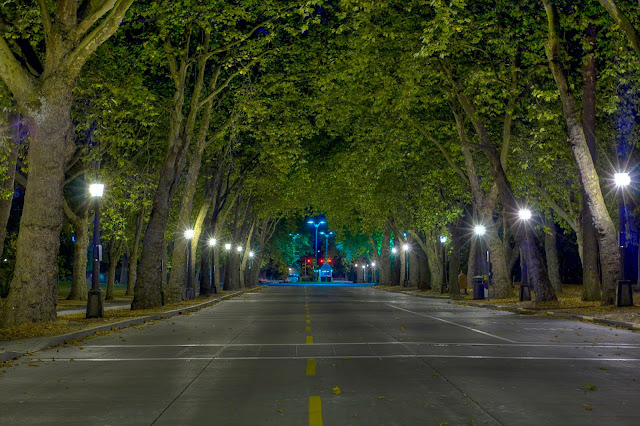
Memorial Completed:London Plane sycamore trees were planted in 1920, two stone pylons were placed in 1928

More than 1,500 students and faculty members were enrolled in military service from April 1917, when America entered World War I, until the war ended with an armistice on November 11, 1918. A total of 58 alumni, students and faculty members died in the war. The University of Washington was unique among institutions on the West Coast in offering training for the three military branches: Army, Navy, and Marines. The largest encampment, which took over the golf course on south campus, was dedicated to naval training. Temporary housing arose for more than 700 Navy men, including some who had recently been students and some who were already in the Navy. The space reverted to a golf course after the 1918 armistice. It is now the sit of the Warren G. Magnuson Health Sciences Center and UW Medical Center. (University of Washington, Antoinette Wills and John D. Bolcer).

History of the World War I Monument

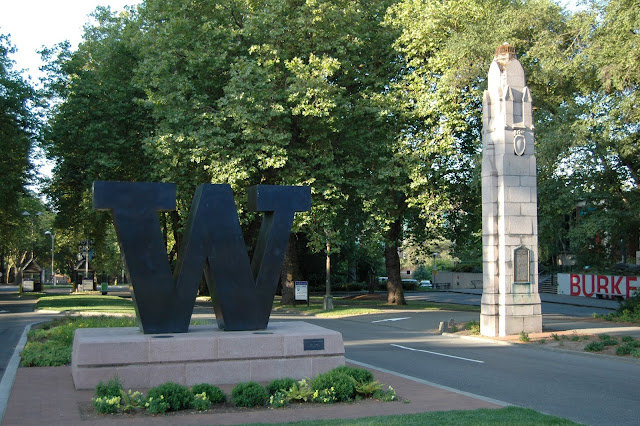
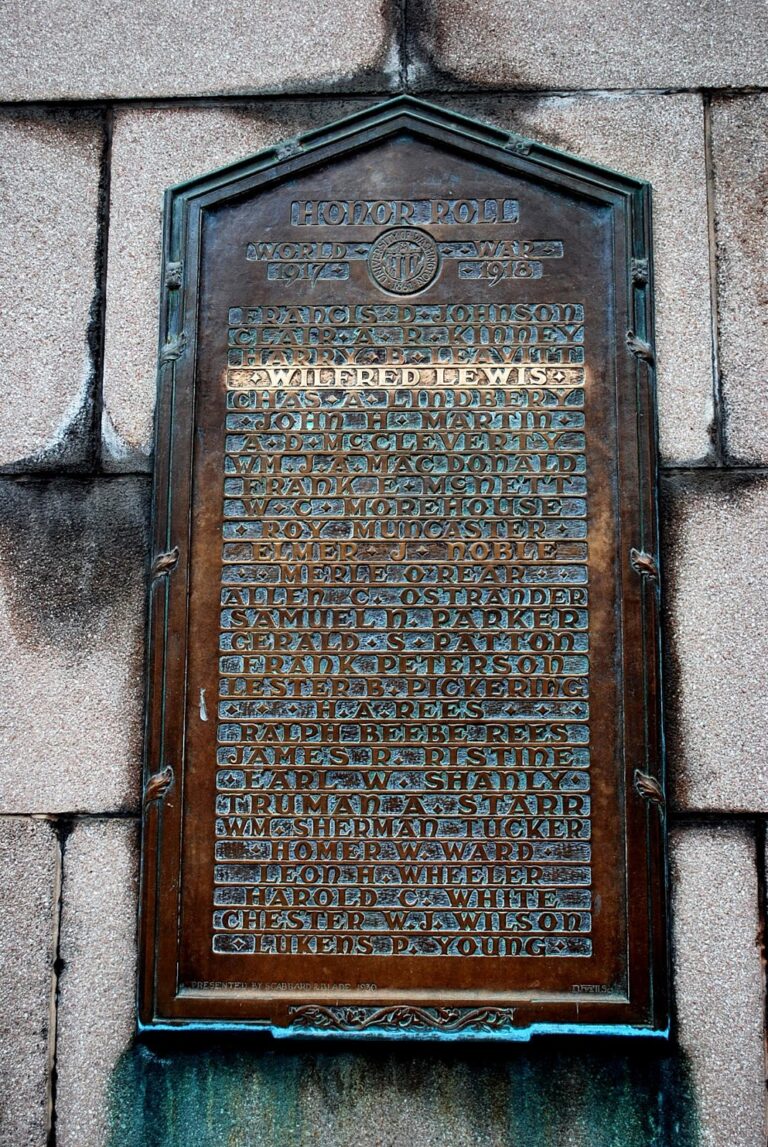
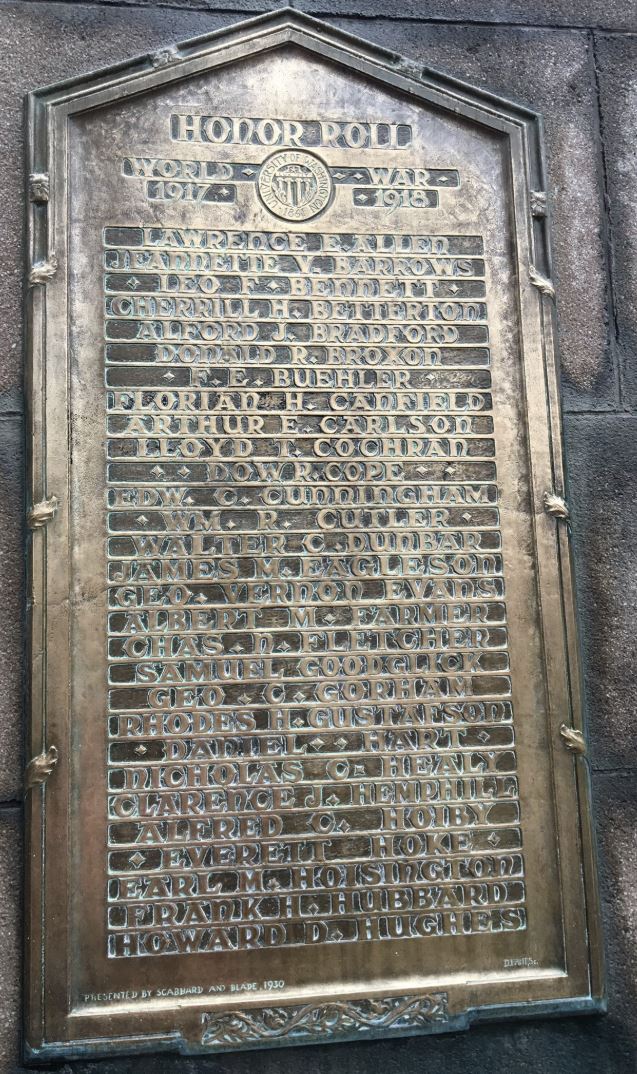
The University of Washington’s World War I Memorial features an arch with two pillars containing a plaque with the 58 names of the fallen soldiers from University of Washington. It also features a long row of fifty-eight London Plane (sycamore) trees dedicated to those soldiers, as tree planting had always been a common tradition of the University. Today, the World War I Memorial has expanded across an entire street, Memorial Way, with a total of 101 trees, and is still well maintained and deeply appreciated by University of Washington staffs, students, and many visitors (Marmor 1).

Although is it much appreciated today, at first, there was much debate as to whether the University of Washington should dedicate a memorial to its fallen students, staffs, and alumni. But after receiving positive responses about the idea, University of Washington began planning the Memorial with Edmond S. Meany, a professor at the University of Washington who led the project.

On July 11, 1918, Judge Clay Allen contacted Henry Suzzallo and proposed an idea. He suggested that a memorial gate should be constructed in memory of the University’s men and women in the Spanish-American War as well as World War I. Suzzallo responded by explaining that creating a memorial based on similar intentions was already under consideration. The idea was for this memorial to recognize those who were currently in war as well as those who had passed, and will pass. But, however, there was an issue due to a “lack of accurate information.” Suzzallo stated that there had been a decision to create one memorial after the war commemorating all the past and current University members who have passed. He also said that a separate memorial was to be created commemorating those in the Spanish-American War. This correspondence between the two led to the beginnings of the memorial (UW 1).

Later, on April 21, 1920, members of the Senior Memorial Committee from the Class of 1920 decided to propose a more direct and specific plan for a Memorial Gate. They chose a location of the memorial, which was an entrance of the campus on Forty-fifth Street and Seventeenth Avenue north-east. Carl F. Gould aided these people in the project by preparing and approving design ideas (Kindig 1).

Fully aware that the construction of such monument is a demanding process, the committee members suggested that each graduating class, beginning with theirs, contribute in some way. Their idea was to have each graduating class add a part to the gate until it is completed. They also had the idea of each graduating class financially contributing to the project as well, so that no individual group assumes too much financial burden.

Under the supervision of Suzzallo, the planning of the memorial then took off. On Armistice Day, 1920, the planting of the initial trees had occurred. This was followed by an exercise, which took place in Meany Hall. However, many later felt that additional work had to be done. On March 26, 1930, various students, including some from the Oval Club developed interest in further advancing the memorial. They intended to add bronze tablets with the names of those commemorated, as well as raising money for the other additional aspects that are yet to be completed. Because of individuals like these and countless others, the memorial was completed and stands today as a wonderful reminder of the selfless service and heroic actions of those from the University of Washington. World War I was a very important time for the University of Washington. The University’s students and staff contributed to the War greatly and were extremely active participants during that historic time (UW 1).

References

91st Division Publication Committee. The Story of the 91st Division. San Francisco, CA: H.S. Crocker, 1919. Print.

Kindig, Jessie. “Northwest Antiwar History: Chapter 1.” Intro: Labor and WWI. Web. 28 Jan. 2017.

Marmor, John. “March 2002 Columns Magazine Feature: A Place Apart – Memorial Way.” March 2002 Columns Magazine Feature: A Place Apart – Memorial Way. Web. 28 Jan. 2017.

UW Health Sciences Library. UW Health Library. Web. 25 Jan 2017.